

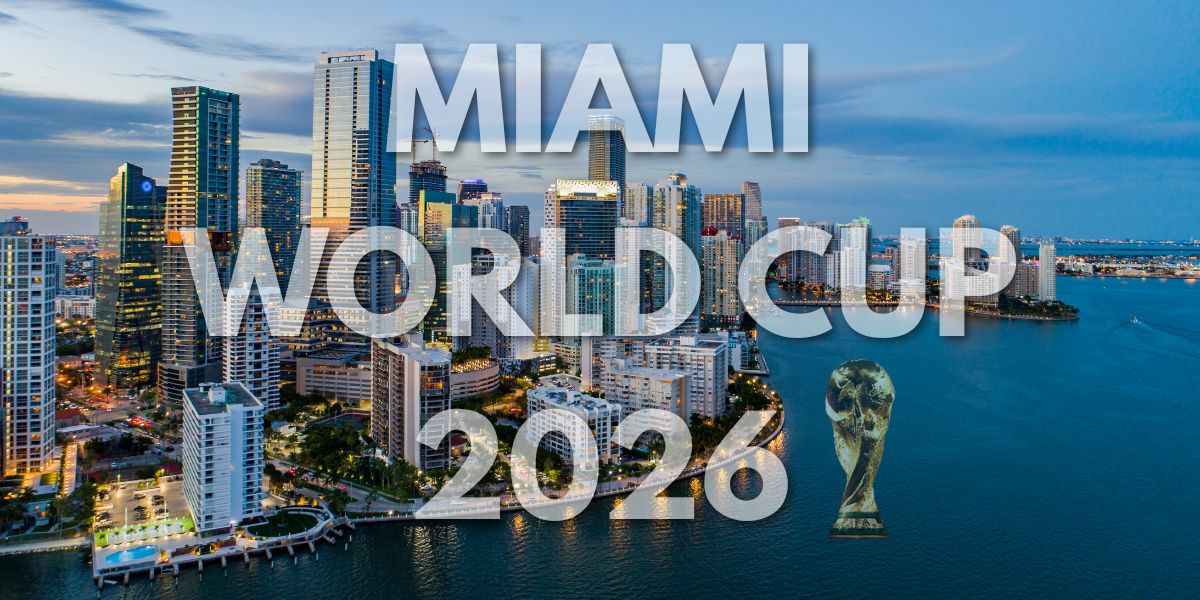
The official announcement that Miami will be one of the host cities for the 2026 World Cup has set off alarm bells—positive ones—in the investment sector, especially in the Miami real estate market. It’s not just about soccer; it’s a unique, historic opportunity for urban revaluation, increased tourist demand, and, above all, a direct impact on real estate profitability. Major sporting events always leave an economic mark, and in Miami’s case, this mark promises to become pure gold for real estate investors.
A World Cup that will transform the local economy
The World Cup is not only the most-watched sporting event on the planet, it’s also a catalyst for economic transformation in the cities that host it. For Miami, its role as host city means much more than matches and celebrations. An influx of more than 500,000 international tourists is expected during the tournament, representing massive and seasonal demand for accommodations, shopping, services, and transportation.
This sudden increase in visitors will translate directly into an increase in short-term rentals, significantly boosting the revenue of properties that already have STR (Short-Term Rental) licenses. In key neighborhoods like Miami Beach, Downtown, Brickell, and Wynwood, owners will be able to increase their nightly rates by 100% to 300% during tournament weeks. The result? Unprecedented real estate profitability in a very short period of time.
Revaluation of strategic areas
The World Cup will also accelerate the appreciation of key urban areas. Infrastructure development, public transportation improvements, street redevelopment, green spaces, and urban environments around Hard Rock Stadium and Downtown Miami will boost the value per square foot in these areas.
Historically, after events like the Olympic Games or World Cups, host cities have seen increases in real estate values of between 15% and 35% in targeted areas. Miami will be no exception, and investors who buy before the event will be ideally positioned to capitalize on this surge.
Increase in foreign investment in real estate
Miami is already a favorite destination for investors from Latin America, Europe, and Canada, but the 2026 World Cup will act as a powerful amplifier. With millions of eyes on the city for several weeks, the international exposure of the Miami real estate market will skyrocket.
Many visitors will be looking to acquire properties, either as income-generating assets in STR or as second homes. Furthermore, media and social media visibility will increase the appeal of investing in luxury developments and properties in areas with high capital gains potential.
Benefits for STR-licensed projects
One of the most beneficial sectors will be properties licensed for short-term rentals. In a city where obtaining a STR license is increasingly difficult, projects that already have one will become premium assets. Buildings like 72 Park, Natiivo, The Elser, and Lofty Brickell, licensed for daily rentals, will see unprecedented demand during the World Cup.
Furthermore, platforms like Airbnb and Booking.com project a 250% increase in bookings in host cities. High occupancy and premium rates will allow investors to recoup years of ROI in just a few months.
Boosting the development of new constructions
With the projected increase in tourism, global visibility, and demand for properties, developers are investing heavily in Miami. A boom in new construction of luxury condos, boutique hotels, and rental-oriented multifamily properties is already on the horizon.
Investors who enter pre-construction projects before the World Cup will be positioned to see rapid and sustainable appreciation, in addition to benefiting from flexible payment schemes and prices below final market value.
Diversification of investment opportunities
The World Cup will also bring new investment profiles. Not only will large capital be involved; small and medium-sized investors will also have the opportunity to acquire fractional properties, hotel-style units, or even participate in collective funds focused on real estate in Miami.
This democratization of investment will be key to further boosting the Miami real estate market by opening the door to new players and fresh capital.
A legacy beyond football
The most powerful aspect of the World Cup won’t be the event itself, but rather the urban, economic, and cultural legacy it will leave in the city. For the real estate market, this means a new chapter of expansion, consolidation, and global appeal.
Miami will consolidate its position as one of the most profitable real estate capitals in the Western Hemisphere, where real estate is not only a safe haven for value, but also a real opportunity for sustained growth.
The 2026 World Cup will be much more than a sporting spectacle: it will be an economic milestone for Miami. For those who understand the pulse of major cities and the windows of opportunity, investing in Miami’s real estate market now is a strategic decision, backed by figures, projections, and unprecedented visibility.
The clock is ticking. The ball hasn’t rolled yet, but the opportunities are already in play.


