

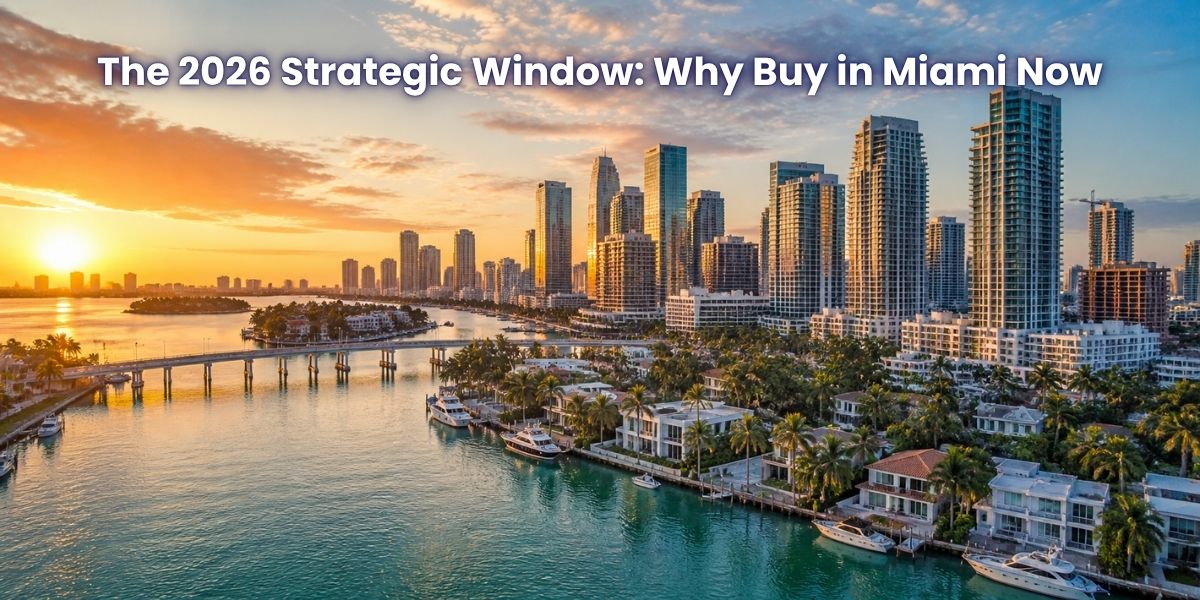
The Miami real estate market entered 2026 calmer, more selective, and—for investors who know how to read the signals—more interesting than ever.
Over the past three years, Miami experienced an unprecedented real estate boom. Prices surged week after week, deals closed within hours, and buyers made decisions without even visiting properties. That cycle has ended. And contrary to what many think, this is excellent news for those considering investing today.
What we have now is a market that has reorganized: more available inventory, more time to analyze, better negotiating conditions, and economic fundamentals that remain exceptionally strong. This is not a correction—it’s a breather before the next push.
A Market Rebalancing, Not Declining
The data from Q1 2026 tells a clear story: Miami-Dade recorded a 10.9% increase in sale prices and a 10.6% growth in closed sales compared to the previous year. Cash transactions—the most reliable indicator of investor confidence—jumped 23.9%.
These are not the numbers of a struggling market. They are the numbers of a market that has found its natural rhythm after years of extraordinary acceleration.
Miami is not in a bubble. It’s at the exact point where strategic buyers enter before the market accelerates again. — Q1 2026 MARKET ANALYSIS, SOUTH FLORIDA
Between 2019 and 2025, single-family home values in Miami-Dade grew by approximately 77%. Far from being unsustainable, industry analysts point out that this growth was driven by structural factors—migration, employment, international demand—rather than easy credit as seen in 2008.
Three Structural Reasons to Trust Miami
Migration Isn’t Slowing Down
Florida continues to attract individuals and companies leaving high-tax states. Entrepreneurs, executives, and high-net-worth families from New York, Chicago, and California keep choosing Miami as their base. This is further reinforced by a steady inflow of Latin American and European capital seeking a safe market to preserve and grow wealth.
The Strongest Rental Market in the South
In 2026, Miami leads the multifamily market across the southern United States. The county’s vacancy rate stands at just 6.6%, the lowest among major cities—well below the national average of 7.3%—outperforming competitors like Dallas, Atlanta, and Austin. For rental investors, this is the key metric: units fill—and they fill quickly.
Infrastructure That Multiplies Value
Properties located near the Brightline station in Miami have seen resale values increase by over 130% since 2018. The train expansion, upgrades to the international airport, and the opening of Miami Freedom Park are real catalysts transforming entire areas and boosting surrounding property values.
4%
Miami Realtors projects a 4% increase in single-family home prices by the end of 2026.
+40%
More than 40% of transactions are all-cash, signaling strong investor conviction without reliance on financing.
56%
More than half of Miami submarkets are reporting increases in asking rents in 2026.
5.6%
Single-family home sales are projected to
grow by 5.6% year-over-year.
Where Are the Opportunities Today?
The Miami market in 2026 is not uniform. Ultra-luxury and waterfront areas remain at historic highs. Meanwhile, certain mid-market segments offer more accessible entry points with equally strong fundamentals. Knowing the map is key.
Brickell
Miami’s financial hub. Constant demand from professionals and high liquidity. Iconic towers redefine the skyline.
Wynwood
Creative district with strong rental demand. Tech and arts community. High return per square foot.
Edgewater
Actively transforming. Strong population growth and attractive returns. Balance between demand and efficiency.
Sunny Isles
A magnet for Latin American investors. Luxury oceanfront towers and solid historical appreciation.
Coral Gables
Premium residential profile. Sustained demand driven by location, schools, and connectivity. Long-term value.
The Most Costly Mistake: Waiting
There is a widespread idea among investors: wait until a project is nearly completed before committing. It’s understandable. But in markets like Miami, that instinct comes at a real cost.
New construction properties in areas with planned infrastructure improvements deliver the highest capital gains to those who enter early. When the stadium is open, the train is running, and the neighborhood has already transformed, prices already reflect all of it. The opportunity is gone.
Why Act in 2026?
→ More available inventory = more time and negotiating power
→ Prices projected to rise 4% by year-end
→ Low vacancy rates ensure rental income
→ New infrastructure driving value in key areas
→ Foreign buyers enjoy full property rights, no residency required
→ No bubble: supported by strong buyers, not easy credit
Miami in 2026 is no longer the frantic market of 2022. It’s something better for the strategic investor: a market where you can think, analyze, and make the right decision. But that window won’t stay open forever.
Ready to find your property in Miami?
Schedule a personalized consultation and we’ll help you identify the opportunity that best fits your investment profile.

